book bug
my reading log for book bug, a neocities book club. one book a month.

2026
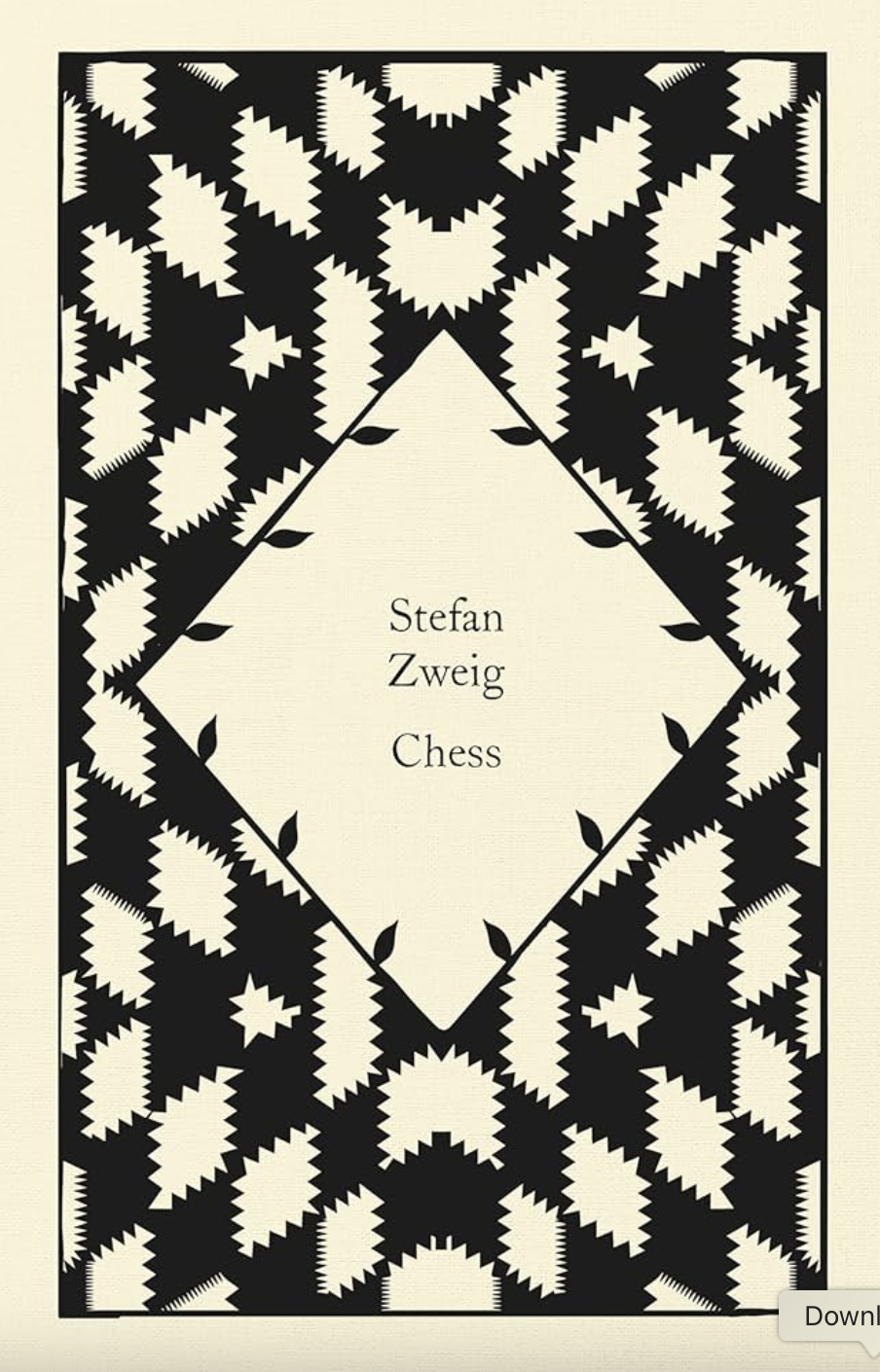
February 2026
Chess
Stefan Zweig
before reading
I'm currently reading The Coming of the Third Reich by Richard J. Evans to understand how the Nazis came to power; this book feels like a compelling complement. The introduction by Peter Gay makes it seem like Zweig is less than explicit in much of his commentary—I look forward to examining the subtext. I'd be lying if I said I wasn't drawn to this book due to the author's tragic suicide. I'm often drawn to literature whose protagonist is "off" in some kind of way—afflicted, tormented, lost—and while Zweig is not our protagonist, one must imagine that pieces of him are inseparable from the story.
My question is similar to that of Gay's: Is this a story where the afflicted find a way out? Or does the story reflect Zweig's ultimate conclusion? Was this, in any way, him reasoning through his life (and death)? If the afflicted does find a way out, what would that mean for Zweig?
▶ after reading
I'll preface this by saying I do not tend to look up much about a book before writing reviews (though I do tend to afterwards), and that I may be way off base in my interpretation, which is greatly informed by the aforementioned book on Nazi history that I am currently reading. Additionally, this is more of a spitball of thoughts than a cohesive review. Nonetheless, I thought The Royal Game was fantastic (5 stars).
I mentioned in my pre-read I was exploring whether Zweig was, by way of extended metaphor, gaming out his personal destiny. I believe this to be the case (or, at least, I think his dilemma greatly influenced this story).
I often find I can give far greater advice to friends than I can to myself. Assuming the role of an outsider yields a distance with which one can assess and advise faithfully. In opening the story in a first-person narrative, I was forced to ask whether Zweig himself was our narrator; it seems to me that he instead writes this character in the first person to give himself, the author, an outsider's distance.
The central turmoil in The Royal Game is a series of chess games between Dr. B — an exile from Nazi-occupied Austria — and Mirko Czentovic, a rather brutish man who nonetheless finds success and pride as a chess savant and world champion. Looming in the background of these games is Dr. B's history, as the reader gleans he learned chess while imprisoned by the Nazi regime, and is only freed after demonstrating his insanity by grabbing a prison guard and demanding "Won't you make your next move, you scoundrel, you coward!" With this, Zweig very directly ties together the literal game of chess being played, and the figurative match being played between the Nazis and their opponents.
If Dr. B may represent those opposing Hitler, then it stands that Czentovic may represent Hitler. There are indeed many parallels. Both represent success in beating their opponents at their own game, despite their intellectual shortcomings: Hitler one-upped the Social Democrats and Communists at political organizing, Czentovic bested the world at chess. As our narrator was drawn to Czentovic's 'monomaniacal' obsession with chess, so too has Hitler's obsession with antisemitism attracted the rapt attention of many historians and laymen. Both are regarded, in their time, as being greater than Napoleon in their trade. This success for Hitler mirrors that of Czentovic who "transformed his original lack of self-confidence into a cold pride".
While I do not believe Dr. B is Zweig himself, I believe he is a necessary part in representing Zweig's internal struggle. As Dr. B and his associates aided the clergy for many years — a group persecuted during the prior regime established by Bismarck as well as the Nazis, and that largely sought to 'play by the rules' rather than arouse trouble — he is established not as a freedom fighting revolutionary, but instead more akin to our author: an intellectual quietly looking to influence change in his own way. He is, like our author, also deciding whether it is worth it to play the game at all.
The story plays out on these two levels that intertwine; the game's destiny in lockstep with Dr. B's, and that of everyone who wishes to see the efforts of the intellectual beat those of the lucky, arrogant, anti-social brute. Dr. B's desperation to learn chess in the first place, while confined alone in the literal empty space created by the Nazi captors, may reflect the desperation of the German public in the wake of the vacuum that Hitler created as he sought to destroy cultural institutions he saw as antithetical to his propagandistic German vision. Upon literally stealing the rules of the game from a Nazi guard, and desperate for some challenge in what becomes a cultural and intellectual vacuum, Dr. B becomes entirely focused on playing chess. In response to the totalitarian regime, Dr. B becomes totally absorbed in responding to it.
But, crucially, to what end? The game itself is not a raison d'etre. This can be clear to outsiders, who find the game incomprehensible, but those involved on both sides are depicted as completely absorbed by the war they are waging for war's sake.
Czentovic loses. He clears the board and acknowledges defeat. But then he asks if history might be a cycle; he requests another game. Dr. B, so enthralled at this point, may more aptly now represent the totality of the Allied effort against Hitler. Written in 1941, Zweig did not see Hitler lose. But he imagines that if he did, the outcome might be that the Allies, so obsessed with the game itself, would continue in some form playing — eventually themselves losing.
But one has to question if the ending for Dr. B and our author might have been different, had Zweig been able to see 10 plays ahead, rather than just three. Though nihilistic, there's some prescience in this reading of the ending if one is to take into account the proxy battle that was the Allied division of Germany, the subsequent proxy wars of Korea, Vietnam, and countless others during the Cold War. And then today with a world scarred by 21st century interventions by two of the then-victorious powers: the United States and Russia. Maybe that will be our undoing, and this thread of history will continue such that playing the game at all would have proved pointless. I cannot blame him, in exile in 1941, if this was his perspective. But I think this ending as written by Zweig might refuse to consider a possibility that Dr. B eventually withdraws victorious; that fighting to a certain point is worth it, and a brighter future is reflected in the self no longer engrossed in the game. Who can say.